
Nathan Graham 5 March 2026
The $50k cost of waiting for rates to drop
The "Interest Rate Trap" and why timing the market is a losing game for first-time investors. Investing for the first time can be nerve-racking, especially when the market is something that ebbs and flows. New investors can be pulled in two different directions: Do you buy now, or wait for interest rates to drop? What will happen to the market in the meantime?
While you wait for a 0.25% drop in interest rates - the kind of increment the Reserve Bank has dropped previously - the market might not be standing still. The problem is that in a market with limited supply, pent-up demand usually leads to a price surge the moment rates dip. By the time you get your “perfect interest rate,” the price of the house may have already jumped.
The issue with timing the property investment market is that you have two forces working against each other. As rates increase, affordability drops; as affordability drops, so does demand, and therefore prices. The same happens the other way - if houses are affordable due to low interest rates, everyone wants one, so the price increases.
Below is an example of someone who wants to wait a year for the interest rate to drop:
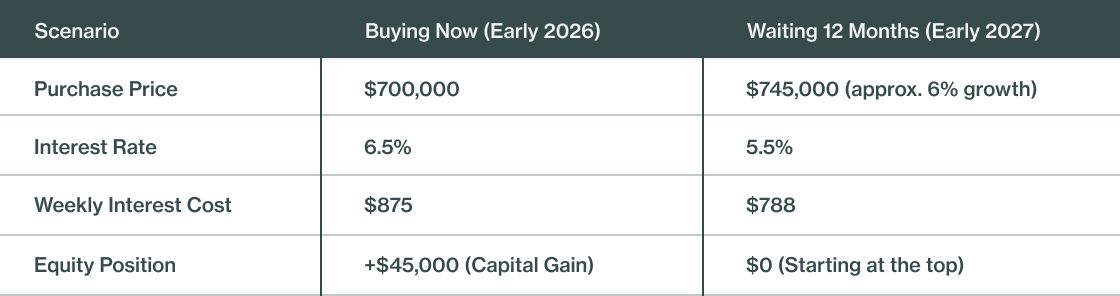
In this situation, the person could lose $50k in capital just to get a slightly lower rate. Now, that’s not to say that you should just buy as soon as possible every time, as there can be valid reasons to wait, but purely holding out for interest rate drops might be hurting you more than it’s helping.
There is one factor that can help make this decision easier - You can change your interest rate, but not your purchase price. If rates are high, this isn't permanent. You can always buy at a low price with high rates, and look to refix at a later date. Buying allows you to lock in prices while markets are quiet, and when rates drop later, you can simply refinance your loan to the lower rate, subject to meeting lender criteria at the time.
So, what if I buy and the market doesn’t rise?
There are a few ways that you can insulate yourself against this. Firstly, you can look to purchase in an "insulated" area. We aren’t looking for areas with massive growth, but areas with consistent growth. You can ask a Property Investment Specialist where these areas might be, but we are looking for areas that rise and fall less than the national average. Where the national average rises 10%, these rise 5%; but where national averages drop 10%, these drop 5%. These areas protect your investment from being a gamble.
Another way - and of course, I’m a little biased here - is to go with a new build. Even in a flat market, a brand-new, Healthy Homes compliant property in a high-demand area can potentially hold value and attract premium tenants compared to old “fixer-uppers.” New builds also come with a 10-year Master Build Guarantee.
Smart investors aren't concerned with when the market is most affordable to everyone; they’re worried about when they can afford their next property, regardless of the market.